Electron bifurcation has recently been discovered as an important and wide-spread mode of biological energy conservation. The process couples exergonic reactions with endergonic reactions to minimize free energy loss. Many enzymes key to bioenergetic processes utilize electron bifurcation, such as complex III, an important protein in the respiratory pathway. To date, little is known about the causes and mechanism of electron bifurcation and why Nature has evolved to use this process. Details gleaned by our studies will inspire the next generation of catalysts to make industrial processes more efficient.
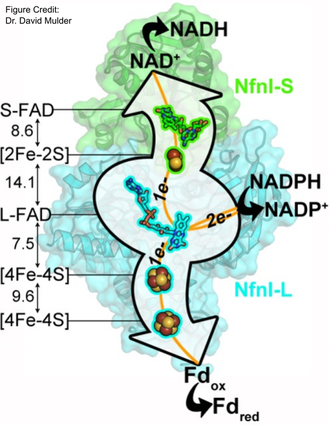
The unique properties of the bifurcating enzyme Nfn were studied using protein film electrochemistry.
|
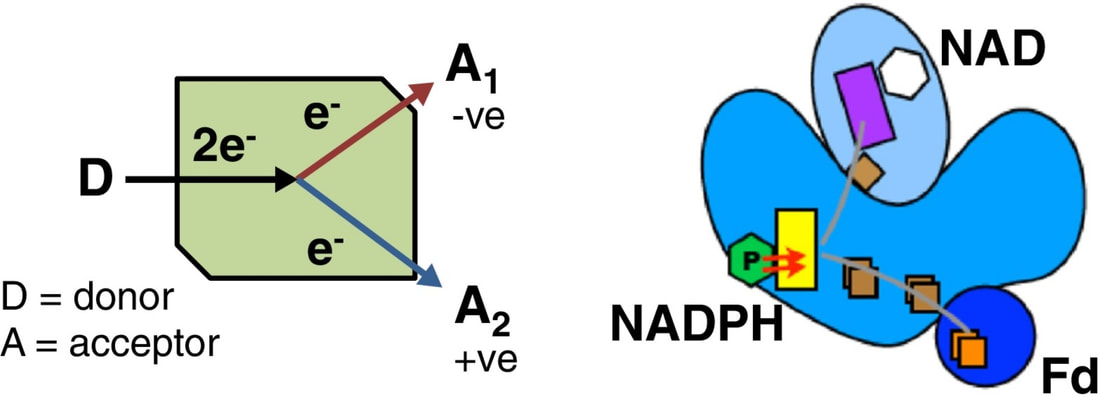
Electron bifurcation is a strategy of conserving energy in redox reactions.
|
Relevant publications
Lubner, C. E.; Jennings, D. P.; Mulder, D. W.; Schut, G. J.; Zadvornyy, O. A.; Hoben, J. P.; Tokmina-Lukaszewska, M.; Berry, L.; Nguyen, D. M.; Lipscomb, G. L.; Bothner, B.; Jones, A. K.; Miller, A. F.; King, P. W.; Adams, M. W. W.; Peters, J. W., Mechanistic insights into energy conservation by flavin-based electron bifurcation. Nature Chemical Biology 2017, 13 (6), 655-+.
Peters, J. W.; Miller, A. F.; Jones, A. K.; King, P. W.; Adams, M. W. Electron bifurcation. Current Opinion in Chemical Biology 2016, 31, 146-152.
